The Faithful
Milan's San Siro and Cluj-Napoca's Dormition of the Theotokos
0-0
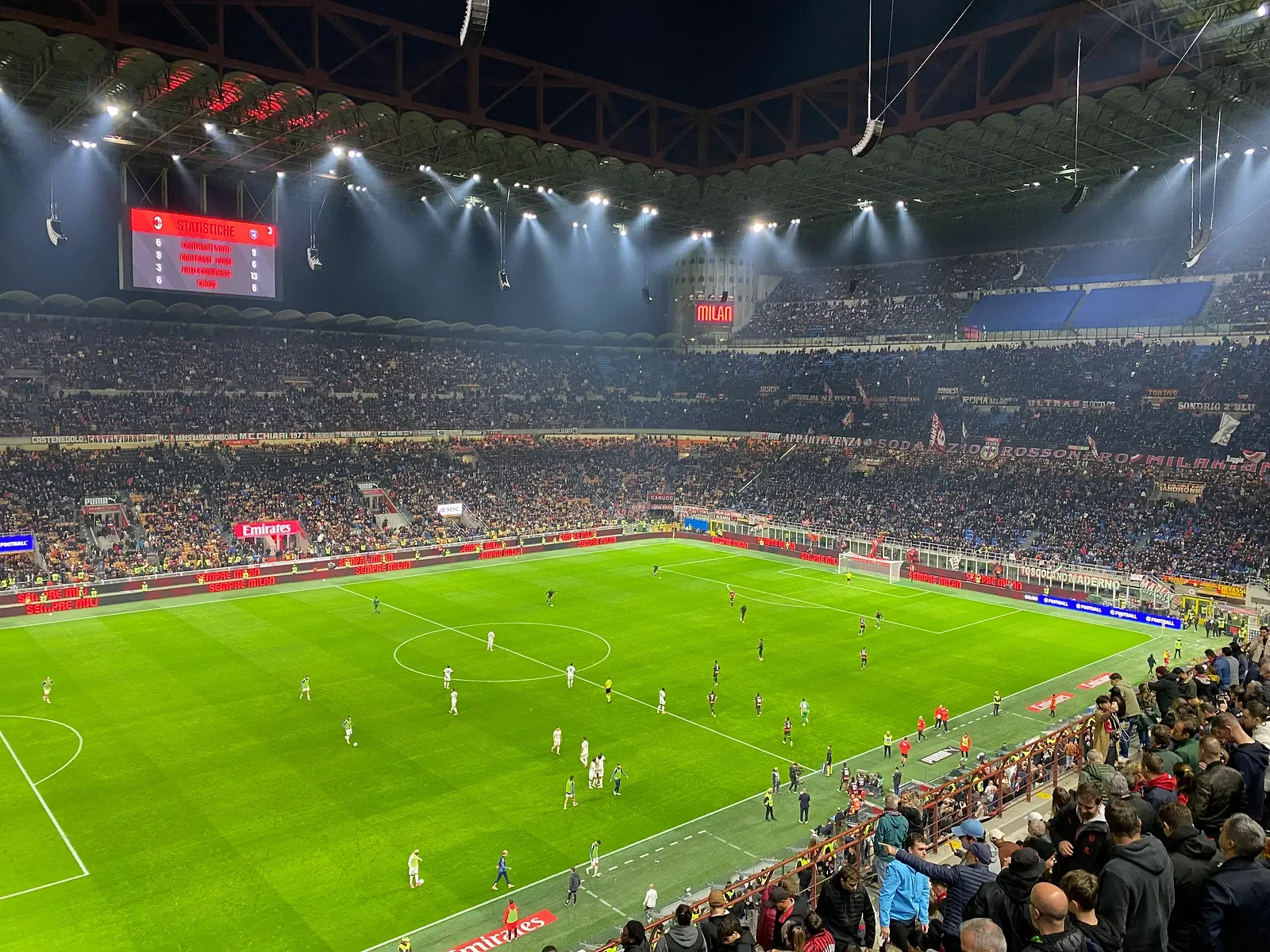
Coming into view for the first time, the San Siro towered above the suburbs, its monolithic concrete pillars floodlit against the evening sky.
Despite my European background, I’d only started following football (soccer) a couple of seasons ago. I’d tried to convince myself not to commit to one particular team, which partially worked. For some inexplicable reason, one of the teams I just kept coming back to was the red-and-black — eventually bringing me to northern Italy on that October night.
AC Milan, one of Europe’s most historic clubs, plays for a 75,000-strong crowd at the San Siro (officially called the Giuseppe Meazza, though Milanisti don’t call it that).
My cousin, his wife, and I shuffled our way into the increasingly congested crowd. Thousands, both young and old, were queueing to watch their beloved Milan play Pisa. Vendors all around us sold jerseys, scarves, warm drinks. We scanned our tickets and made our way into the stadium itself, the old giant coming to life for another night. I went expecting an evening of entertainment, but left feeling something deeper — like I’d been temporarily drafted into an army I could not control. A few weeks earlier, in a cathedral in Cluj, I had a similar sort of experience, only quieter.
I’d visited the main Orthodox Cathedral in Cluj-Napoca on several occasions over the years, but this wasn’t like those times. Though I was traveling alone, I’d run into an artist in Cluj through a coincidence so specific and close to home that it still feels made up. Visiting the cathedral after dark was on both of our lists.
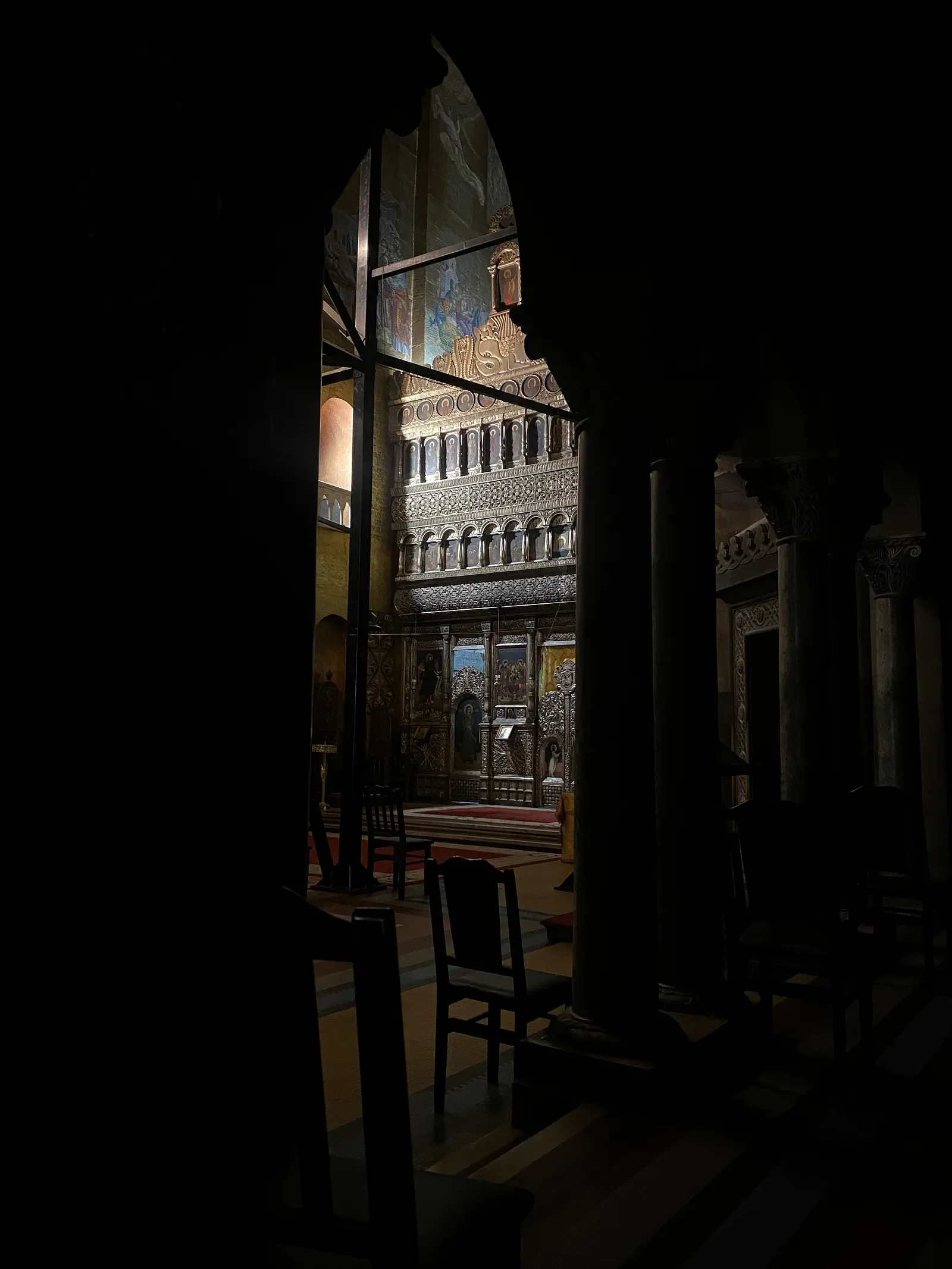
We chatted as we walked under the dark sky, past the rows of Romanian flags fluttering in the wind, past the stone and bronze statue of a Transylvanian revolutionary, up the stairs of the towering entryway. Walking through the large, heavy double doors, we fell silent, hearing our last words echo from the dimly-lit painted ceiling far above us, the smell of incense heavy in the air.
1-0
The three of us quickly found our seats in the second row of section 234. The Curva Sud was already awake while warm-ups happened on the field — Milan’s end behind the goal was packed tightly with their faithful guards in black attire. From our seats across the way, we could spot a handful of men standing with their backs to the field, conducting the others like it was their sacred work, the beating heart of the stadium.
Before the players made their final entrances onto the pitch, a ritual began: a chant adapted from a popular Italian song, its lyrics roughly translating to:
What a mess, maybe it's because I love you
It's an emotion that grows slowly
Hold me tight and stay closer to me…
The Curva’s flags rippled through the air, flashes of color, red and black. In front of us a group of Italian youths had sat down, smoking and drinking.
The referee’s whistle blared out suddenly, cutting through the mesmerizing atmosphere in the full stadium. It was as if this signaled the end of the entertainment portion of the evening. People seemed to quiet down and all turned toward the field, the game had begun.
Milan’s number 10 put the ball into the back of the opponent’s net in the seventh minute, and it almost felt like the stadium was caught off guard. But moments later the announcer called out and the crowd answered loudly in reply, “LE-AO, LE-AO, LE-AO.”
Around the 30th minute, it became apparent to us that the Italians in front of us were in fact not the rightful occupants of those seats. Two tall British men with three small British children, grumbling about crazy traffic, arrived with tickets. Perceiving that the Italians were feigning ignorance and not eager to move, the Brits began unleashing a flurry of increasingly aggressive expletives in their direction. A stadium steward showed up, a girl with a kind, tired face who tried to reason with them — a futile effort.
Behind us the crowd grew agitated by the situation, as this disagreement was obstructing everyone’s view. One particularly vocal man, who turned out to be from the Czech military, stood up behind me and began to yell loudly at the Italians in English, requesting kindly that they “put out their ____ cigarettes and get the ____ out.” I felt the adrenaline increasing — the unified jeers of the crowd all around me were slowly replacing my own free will. I’d never fought anyone outside of a heavy bag in my life, but at the height of their yelling, I was one ounce of willpower away from grabbing one of their cigarettes out of their mouth and flicking it away myself. Thankfully, I kept quiet.
Amid the increased pressure, the Italians admitted defeat and relinquished their places, though they returned a few minutes later at halftime to complain about how they were disrespected. By then, the crowd was no longer interested in this debate and neither was I — I followed the masses into the concourse for a few short minutes back in my own mind.
Though it was late, a few faithful were still present in the cathedral. A woman quietly walked in and crossed herself, venerating the icons and taking the long walk to the front of the room where she knelt in prayer. Each gentle step she took echoed out, and I turned to watch her. An enormous metal chandelier hung over her head, as did the portraits of hundreds of saints farther above her.
We slowly shuffled our way forward along the side of the nave, breathing in the thick air. I turned into one of the side passageways, barely lit, and walked into the candle room. The small U-shaped space was lined with trays of water where candles could be planted: a prayer, a request, a memory. Exhaust fans whirred gently above, but the burnt smell persisted. A few candle stubs were left but none still lit, prayers uttered and answers yet unknown. I reached my hand down to touch the water — small ripples formed. The moment felt ancient, as if from another lifetime.
1-1
Milan dominated the first half of the game but sputtered into complacency after the second kickoff, conceding a penalty in the 60th minute. As the referee pointed to the spot, anticipation grew in the stadium and time seemed to slow. Pisa’s penalty taker lined up, facing the Curva’s whistles and jeers.
The ball soared through the air while tens of thousands all wished in unison that they could be on the field keeping it away from the goal. Yet there was no miracle preventing the inevitable. The ball hit the back of the net and the silence in the bowl was deafening. ‘We’ were no longer ahead.
The crowd doesn’t just share the joy, it also shares the anxiety, the volatility. Tension built in my stomach, the outcome of the match no longer certain. In both places, the atmosphere was dictated by a power far greater than one single person.
We sat down in the dark wooden chairs lining the side passageway, bathing in the shadows. The room felt massive, cavernous even. I picked a seat where you could just see the iconostasis and the towering dome above it, painted ornately with scenes from Christian history. I shifted in my chair and the wood creaked loudly. I froze, ashamed to have interrupted the stillness.
Beside me, the artist wore a calm, faraway look on her face, resembling the fixed gazes of the saints overhead. Golden halos glinted in the dim light, sternly yet somehow also warmly — the types of saints and scenes that the Orthodox faithful have looked at and prayed under for centuries.
We stood and looked closer, motioning to each other and pointing out elements of the paintings and murals we appreciated. Several minutes had now passed without any discernible noise at all in the room — it seemed as if we had both now stepped entirely into this different world; the realities of the outside fading into memory.
1-2
In Milan, one mistake eventually led to another. A well-placed pass glided above many of the defenders, finding Pisa’s Nzola, who effortlessly slotted the ball into the back of the net. Disbelief spread around the bowl. I looked down at my hands, at the red and black stripes streaming down my sleeves. The pit in my stomach grew deeper. Surely this couldn’t be the end…
With only a few minutes to turn things around, the Curva awoke once more, their clapping hands and choreographed chants rushing new blood into the stadium. It seemed that everyone leaned further forward in their seats, willing the home team up the field. It was no longer our eleven versus theirs; the stadium became the 12th man. Each successful move and valiant attempt at the opponent’s goal was met with raucous applause, just as every foul and moment wasted by Pisa was met with loud jeers.
The crowd provided each with the necessary anonymity to do whatever they saw fit to help the team ahead, whether that was insulting the opponents and their few supporters, or cheering on the red and black. The faithful did not capitulate; they were with their own until the end.
We lingered a little longer, poking our heads into a side chapel, looking at the shadows from different angles, stuck under the spell of the art soaring above us. Painful crucifixion, triumphant resurrection, looming judgement. It was nearing closing time; a priest locked one of the front doors, walked the length of the nave, and disappeared through a door in the iconostasis.
We could hear a couple of low voices from the altar area, when suddenly, and unmistakably, a loud sneeze echoed out. It caught my artist compatriot completely off guard — laughter broke through from behind her hands and a brief snort escaped into the room. Both shaken from our pensive moods now — I smiled and whispered that it was probably time for us to move along.
2-2
Only a few moments of injury time remained. The pressure in the stadium was higher than ever, thousands of eyes fixed intently on every dribble. Then, from an improbable angle outside the box, substitute Zachary Athekame drilled a ball that somehow found the bottom corner of the net.
Not half a second later, the stadium shook. Everyone stood, some high-fived their neighbors, others clapped, others whooped. People fumbled with their phones to try and immortalize the moment — our moment. My ears were ringing, but I somehow didn’t seem to mind.
The dying moments of the game were tense, but the crowd was enjoying itself again. In the 8th added minute of injury time, another Milan player dribbled two opponents and took a shot at the goal that drifted just wide, eliciting a loud groan in unison from all corners of the stadium. When the referee blew the final whistle, all rose for one last salute to their warriors — a long sustained applause. A tie wasn't as sweet as a win, but much sweeter than a loss.
As the masses began filtering out of the stadium, I felt my own thoughts returning. It dawned on me that I was, after all, 4,500 miles away from home. I checked my phone, feeling like I had just woken up from a nap and wanted to see what I’d missed.
It was a long walk back to our Airbnb through the late Milan night — parts of the crowd dropping off at each crossroads. This crowd would be back and, in a way, I was already sad that it would go on without me. Thinking back, the Curva is perhaps equal parts showmanship and devotion. Clapping hands forming the beat of a liturgy, the rest of the bowl taking its cues from the loudest in the room. A single voice, a single wall. It was unsettling how quickly I became just another part of the stadium’s will, but now I didn’t want to let it go, either. It felt like I shared a piece of that tie, though I hadn’t done anything to earn it.
I looked back one more time towards the iconostasis, one last glimpse of the glowing golden halos painted above. We stepped back outside into the cool, clean fall air and heard the door click heavily behind us.
Downtown struck me with its noise, its speed. In a small way I’d already grown detached from this reality, content to exist in the confines of the cathedral. I tried to determine how much time had passed since we entered, as cars rushed up and down the boulevards. We were bathed in the orange glow of the floodlights, our steps clicking against the stones below.
We continued walking and talking until late in the night. Our conversation quickly drifted away from the cathedral, but some part of it lingered with me, like the smell of incense on my jacket.
After the Final Whistle
I often still find myself thinking of these two specific nights: not the mechanics of how each goal made it into the net, nor the individual images of the saints, but the sudden moments when thinking was entirely replaced by feeling. In Milan, it happened under the floodlights and noise of the San Siro; in Cluj, it happened amid quiet incense-heavy air under gold halos. The nights were built as much by the architecture as by the faces beside me, even if those people all quickly disappeared back into their own lives.
In both places you enter as raw material and are offered a sense of identity in a purpose larger than yourself. In their own ways, each followed me home: Milan in the way their match results tilt my mood, and Cluj in a quieter way that returns when the noise dies down. One asked for my physical presence and ended with a whistle; the other asked where my hope lies, for this life and beyond it.